








60 Second Test
Understand your company's position and learn more about the options available

Require Immediate Support? Free Director Helpline: 0800 644 6080
Published:
Small to medium businesses across the UK are navigating one of the most challenging trading environments since the coronavirus pandemic. The weight of rising employer costs, weak consumer confidence, and a fresh wave of energy price increases is pushing tens of thousands of businesses to breaking point. For many directors who have spent years absorbing one pressure after another, the first quarter of 2026 has offered little respite.
The Business Distress Index provides quarterly company insolvency statistics and assesses the financial health of small-to-medium-sized businesses in the UK. It provides an in-depth sector and regional analysis, alongside exclusive commentary from Shaun Barton, National Online Operations Director at Real Business Rescue. The Business Distress Index uses data from Red Flag Alert and Companies House.
The Business Distress Index for Q1 2026 shows a significant deterioration in the financial health of UK businesses. Financial distress is categorised as either 'significant' or 'critical', which refers to businesses with deteriorating working capital, retained profits, net worth and contingent liabilities, as monitored by the Business Distress Index.
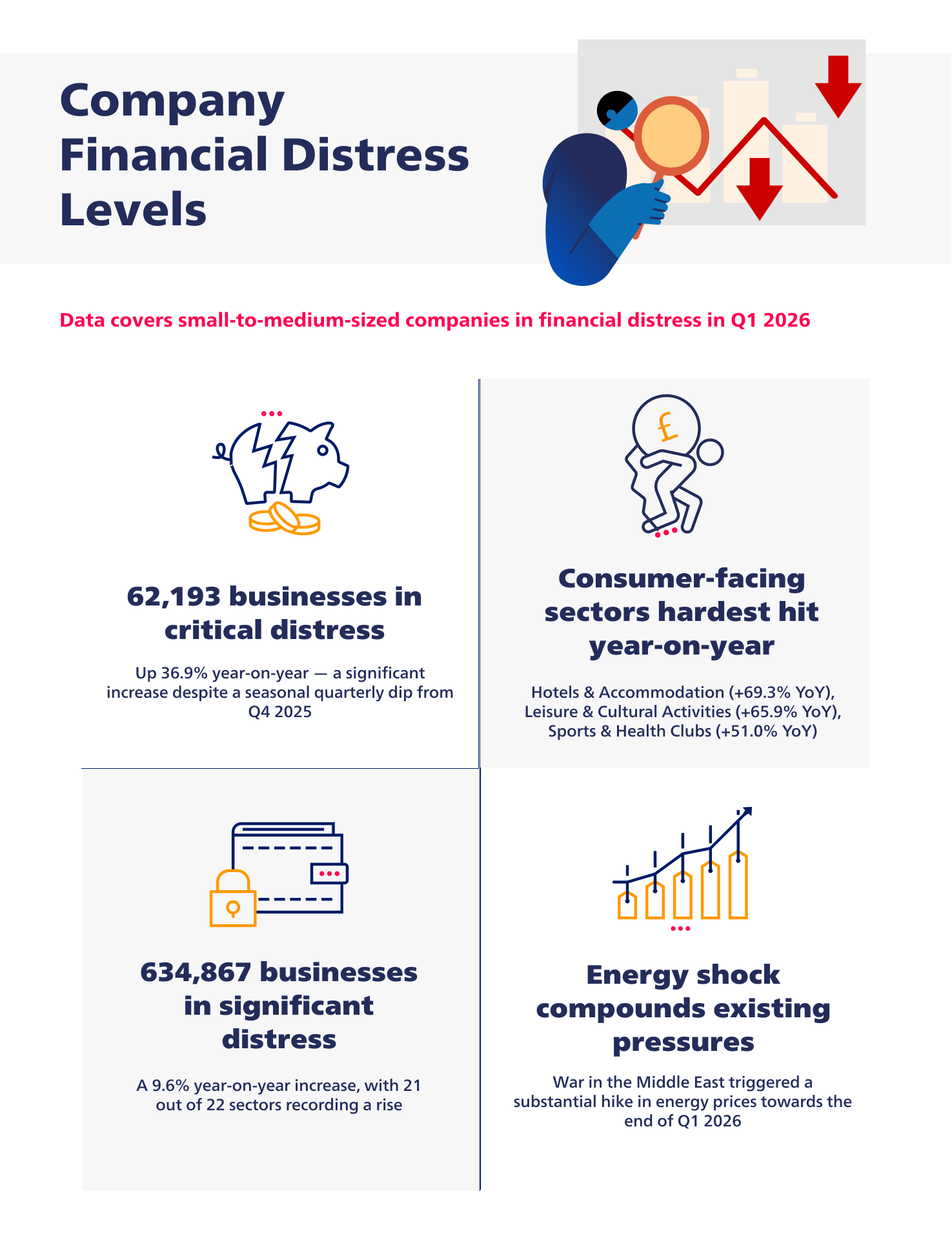
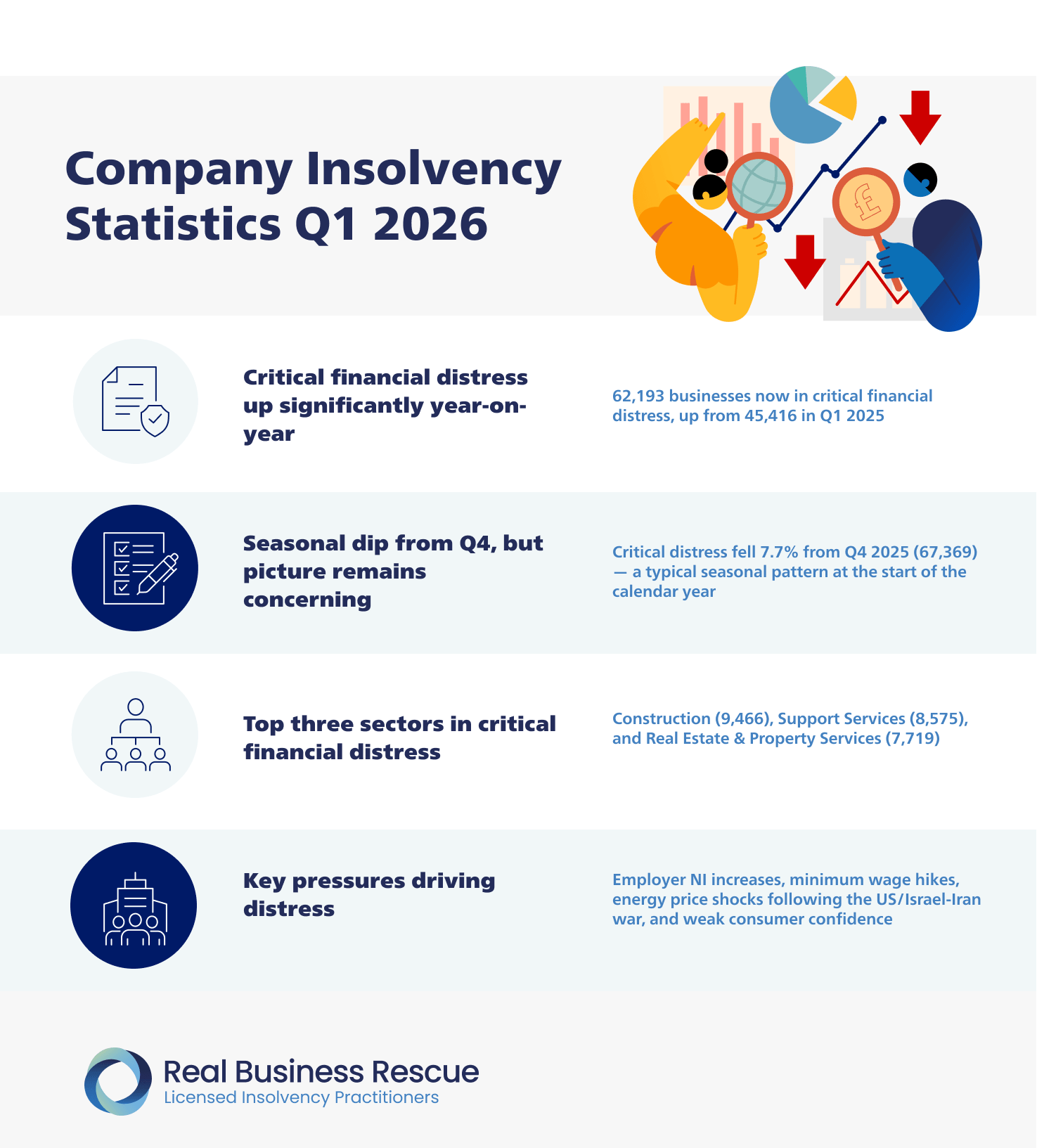
As of 31 March 2026, 62,193 companies were in critical financial distress — a 36.9% increase year-on-year from 45,416 in Q1 2025. Critical distress did fall by 7.7% compared to Q4 2025 (67,369); however, this is a typical seasonal pattern for the start of the calendar year as normal conditions resume. The year-on-year picture tells a fuller story: more than 16,000 additional businesses have crossed into critical distress compared to the same point twelve months ago.
On the significant distress front, 634,867 businesses were recorded in this category in Q1 2026 — a 9.6% increase year-on-year from 579,276 in Q1 2025. Of the 22 sectors monitored by the Business Distress Index, 21 experienced a year-on-year rise in significant distress, while all 22 recorded an increase in critical distress. With all 22 sectors recording a year-on-year increase in critical distress, the data reflects evenly distributed distress across all sectors, rather than isolated distress across a few sectors.
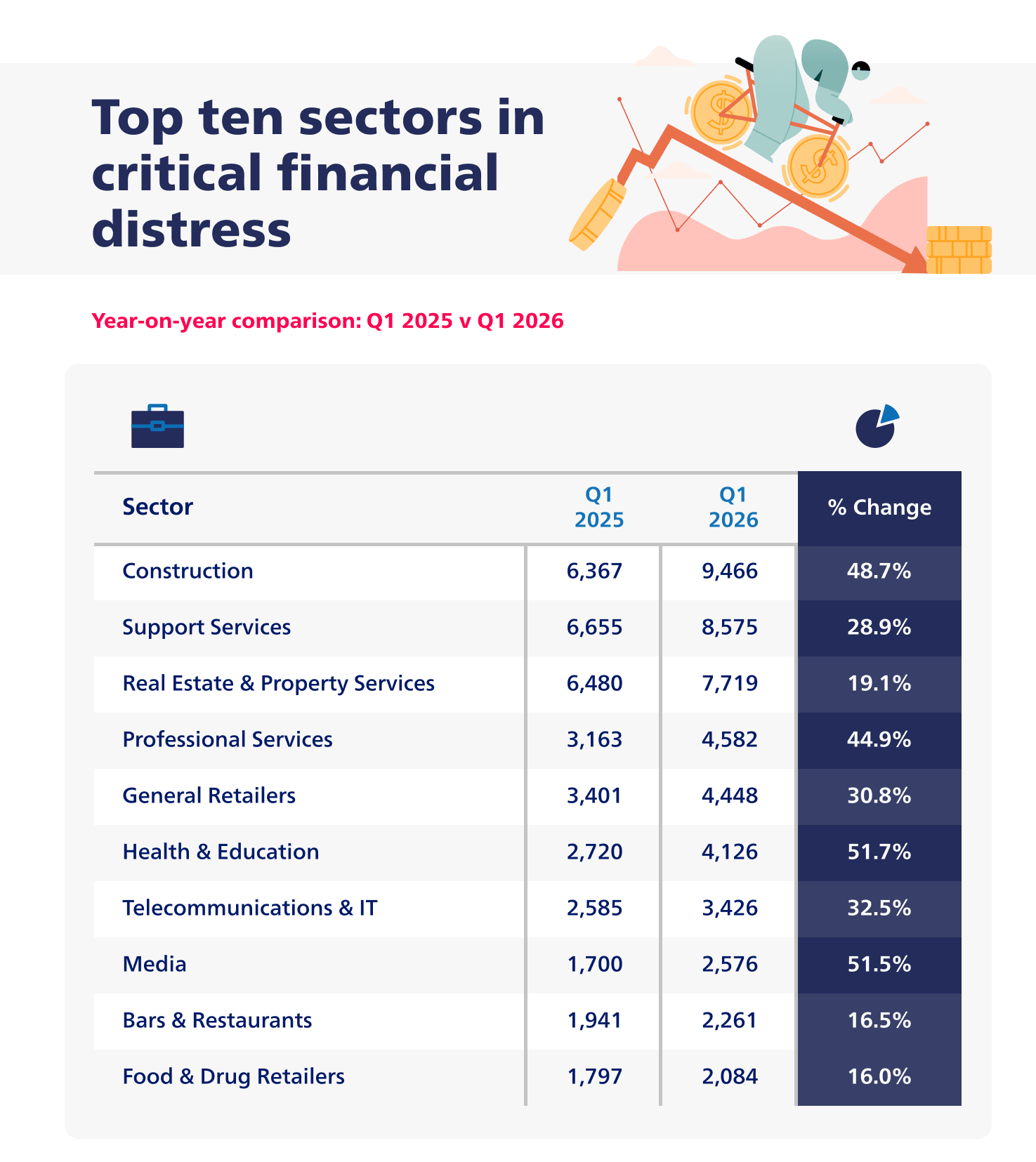
The Business Distress Index analyses key sectors that are the main feeders into the UK economy. In Q1 2026, every one of the 22 sectors monitored recorded a year-on-year increase in critical financial distress, underscoring how widespread the pressure has become.
By volume, the sectors carrying the heaviest burden of critical distress are Construction (9,466), Support Services (8,575) and Real Estate & Property Services (7,719). These three sectors alone account for a substantial share of total critical distress and have remained persistently near the top of this table across consecutive quarters.
When looking at the rate of annual increase rather than volume, the picture shifts to consumer-facing industries. Hotels & Accommodation recorded a 69.3% year-on-year rise in critical distress, Leisure & Cultural Activities increased by 65.9%, and Sports & Health Clubs by 51.0%. These sectors are exposed to discretionary spending, and with household budgets remaining under pressure, footfall and revenues have continued to decline. Health & Education (+51.7%) and Media (+51.5%) also saw critical distress increase by more than half over the year — sectors not always associated with the sharp end of financial distress, but clearly not immune to the broader economic pressures now at play.
On the significant distress side, Construction (+10.5% to 95,355), Support Services (+7.2% to 92,983) and Real Estate & Property Services (+15.1% to 79,118) continue to carry the highest concentrations of businesses under financial strain.
Shaun Barton, National Online Operations Director at Real Business Rescue, said:
“The Q1 2026 data confirms what many directors on the ground have been feeling for some time — that there is no straightforward route back to stability. Rising employer National Insurance contributions and minimum wage increases have added directly to operating costs at a time when consumer demand remains fragile. For labour-intensive sectors like hospitality, construction and retail, those twin pressures are extremely difficult to absorb.”
“What is particularly concerning this quarter is the arrival of a new pressure: energy and materials inflation linked to the conflict in the Middle East. Businesses that had just about found a way to manage their existing cost base are now facing an additional and unpredictable burden. For those already operating with no financial cushion, there is very little room to absorb another shock.”
“The statistics represent directors facing very real and very difficult decisions about the future of their companies. Early advice is always better than delay.”
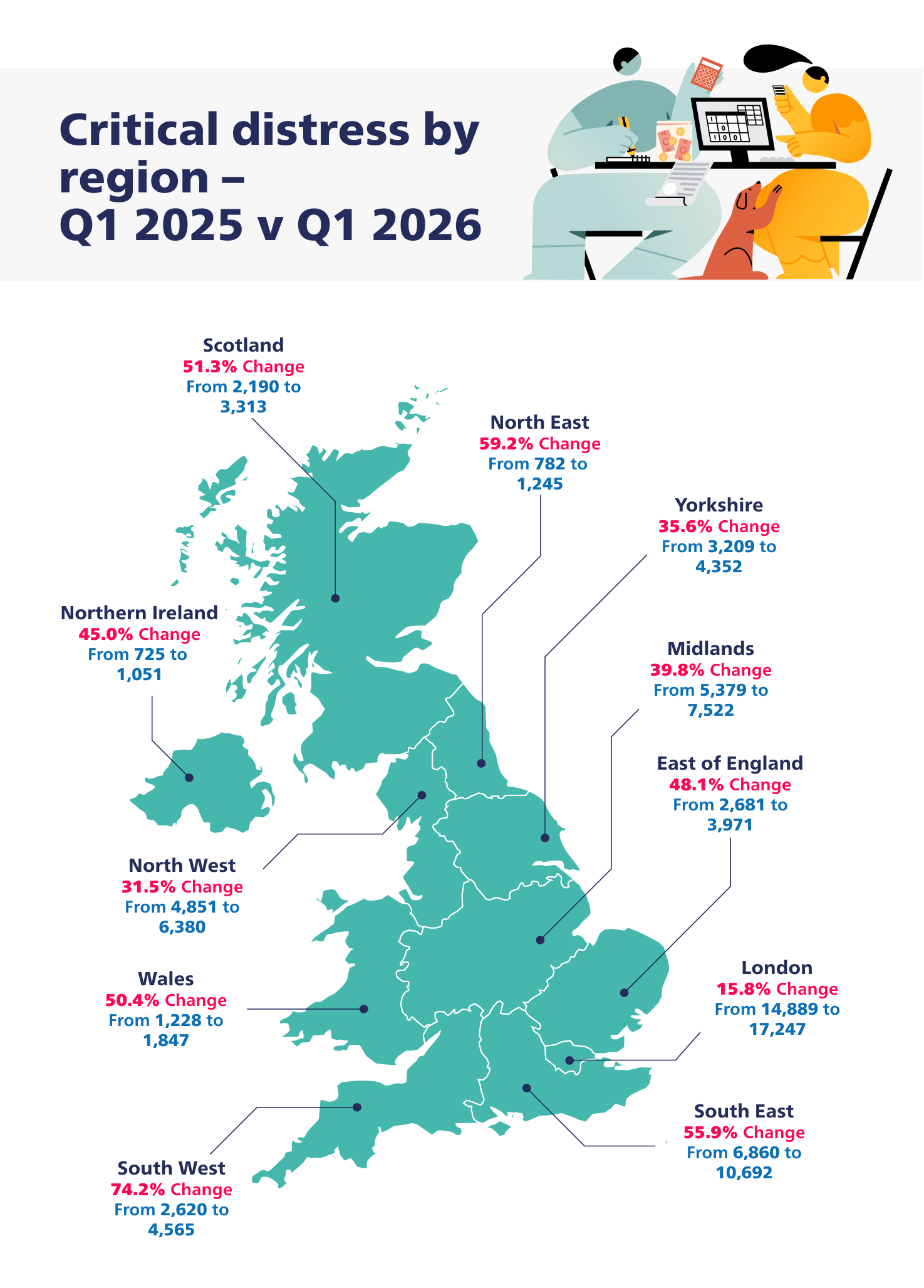
Critical financial distress increased year-on-year across every region of the UK in Q1 2026, but the scale of that increase varied geographically. London continues to carry the highest volume of critically distressed businesses by some distance, with 17,247 companies in this category. However, with a year-on-year increase of 15.8%, London recorded the smallest proportional rise of any region — suggesting that distress is accelerating more rapidly across other parts of the country.
The South West recorded the most striking regional increase, with critical distress rising 74.2% year-on-year from 2,620 to 4,565 businesses. That is a sharper rate of growth than any other region and reflects the vulnerability of an economy heavily reliant on hospitality, tourism and seasonal trade — all sectors that have faced sustained pressure on consumer spending. The North East followed with a 59.2% year-on-year increase (from 782 to 1,245), and the South East saw a 55.9% rise (from 6,860 to 10,692).
Scotland (+51.3%), Wales (+50.4%) and the East of England (+48.1%) all recorded increases of close to or exceeding 50% year-on-year. The Midlands (+39.8%), Yorkshire (+35.6%), the North West (+31.5%) and Northern Ireland (+45.0%) also saw substantial deterioration.
The outlook as the UK moves into Q2 2026 is shaped by a combination of domestic pressures and a volatile global backdrop. The energy and materials inflation that emerged towards the end of Q1, driven by the US/Israel-Iran war, has introduced a significant new burden. For businesses that had been managing their cost base carefully, this represents a further test of resilience.
The increases to employer National Insurance contributions and the national minimum wage that came into effect at the start of the year continue to feed through to operating costs. Consumer confidence remains subdued, and with unemployment expected to rise, the conditions that support discretionary spending are unlikely to improve.
The next quarter will be critical for thousands of UK businesses, as those with tight margins, limited reserves or significant debts will be navigating with little breathing room. For any director concerned about the financial position of their company, taking advice early is the most important step. Our licensed Insolvency Practitioners are available for a free, confidential consultation, contact us today or use our 60 second test to understand your company's position.



Still unsure whether liquidation is right for your company? Don't worry, the experts at Real Business Rescue are here to help. Our licensed insolvency practitioners will take the time to understand the problems your company is facing before recommending the best course of action going forward based on your own unique circumstances.

Complete the below to get in touch
For Ltd Company Directors
What are you looking to do?
Choose below:
We provide free confidential advice with absolutely no obligation.
Our expert and non-judgemental team are ready to assist directors and stakeholders today.
Understand your company's position and learn more about the options available

Find your nearest office - we have more than 100 across the UK. Remote video and telephone meetings are also available

Free, confidential, and trusted advice for company directors across the UK