






60 Second Test
Understand your company's position and learn more about the options available

Speak to an Expert : Free Confidential Advice on 0800 644 6080
: Free Confidential Advice on 0800 644 6080
Published:
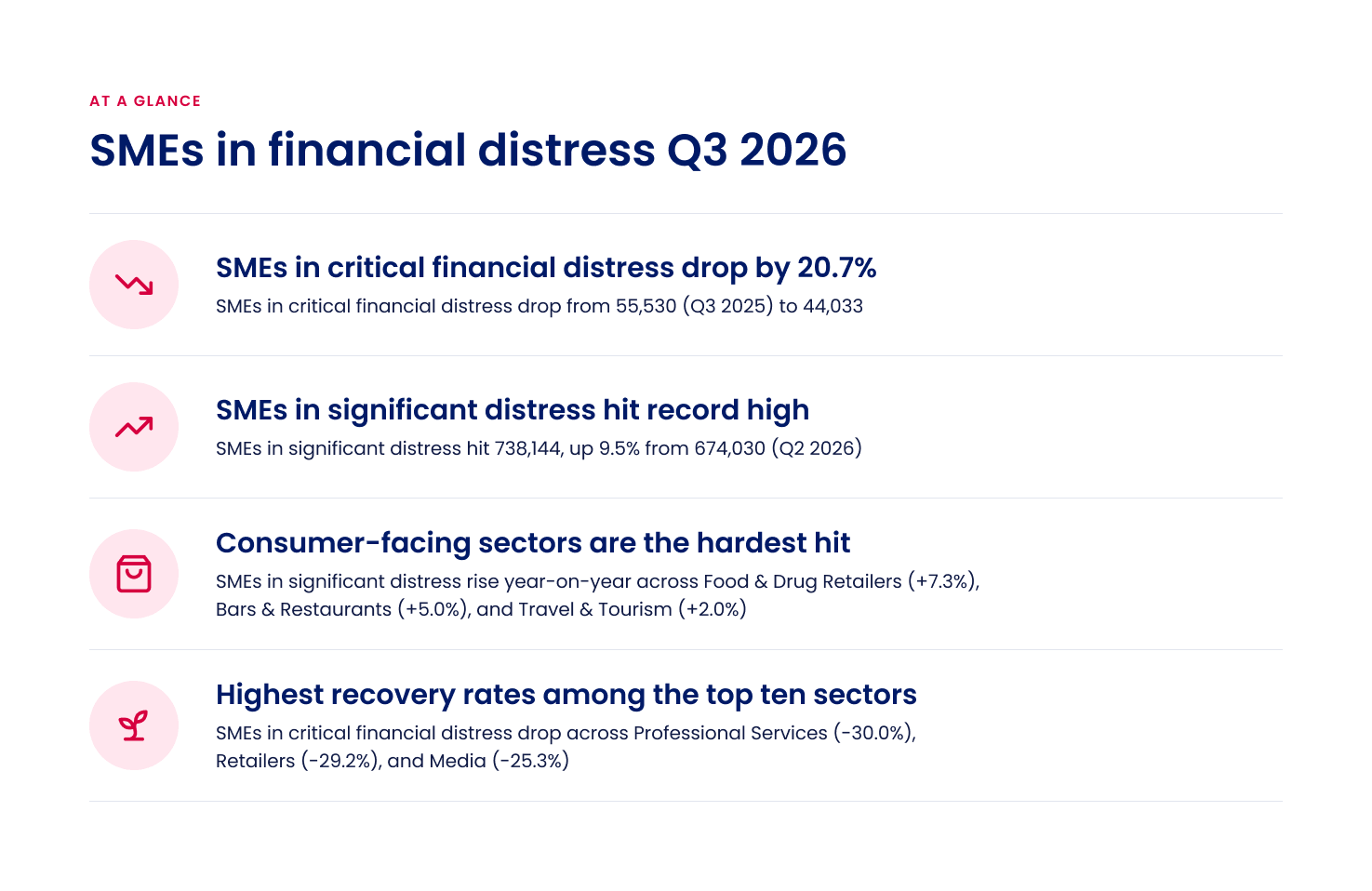
In Q3 2026, 44,033 UK SMEs were in critical financial distress, and 738,144 were in significant financial distress.
Critical financial distress fell by 20.7% year-on-year, from 55,530 businesses in Q3 2025 to 44,033 in Q3 2026. That is 11,497 fewer SMEs in critical distress than at the same point last year.
Significant financial distress moved in the opposite direction. The number of SMEs in significant distress rose by 9.5% quarter-on-quarter, from 674,030 in Q2 2026 to 738,144 in Q3 2026, which is a record-high.
“A 20.7% fall in critical distress is welcome, but it isn’t the whole picture. With a record 738,144 businesses now in significant distress, far more directors are running their companies with very little room for error.”
Shaun Barton, Partner, Real Business Rescue
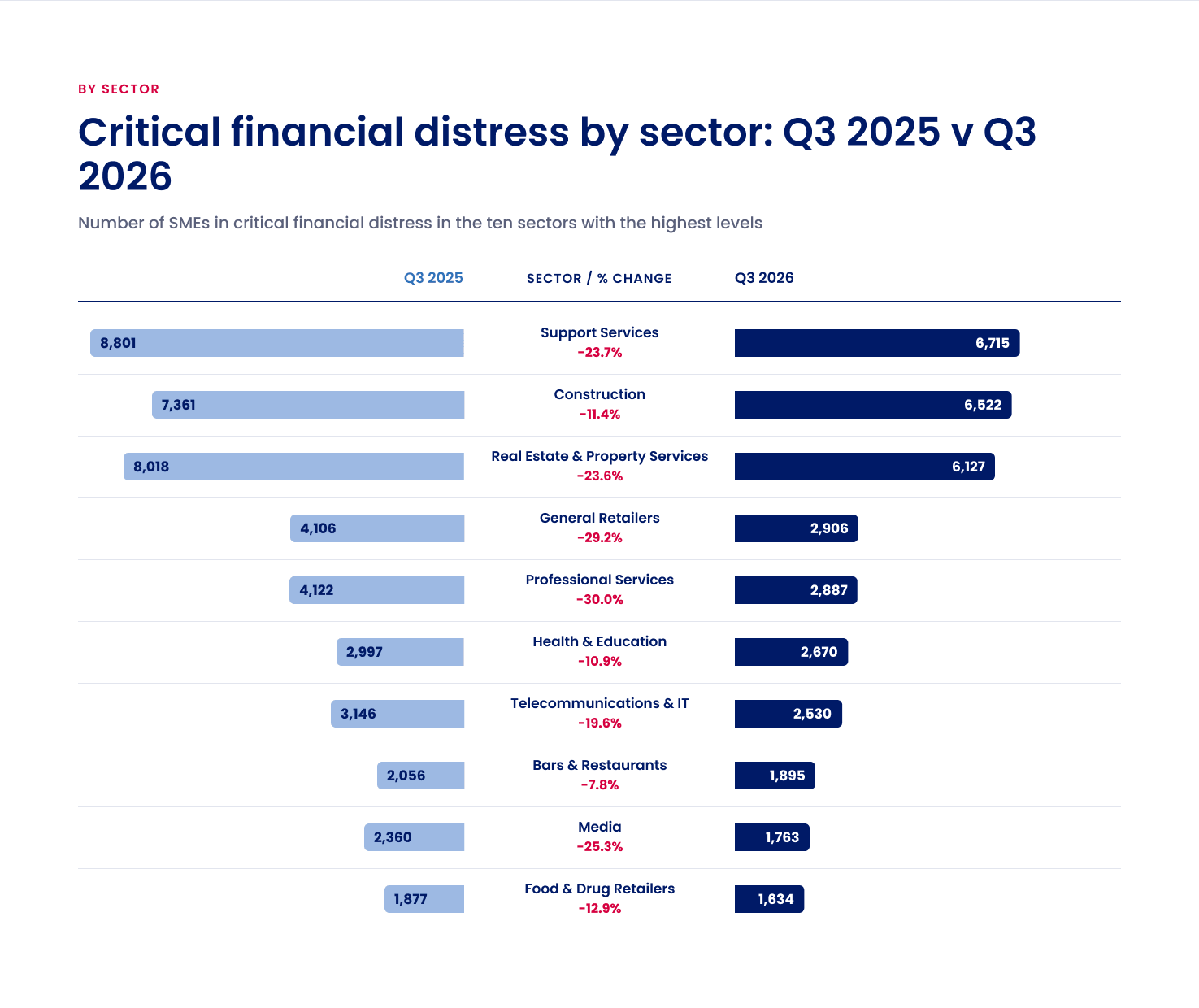
Among the ten sectors with the highest levels of critical financial distress, the largest year-on-year falls were in Professional Services (-30.0%), General Retailers (-29.2%) and Media (-25.3%).
Of the 22 sectors monitored by Red Flag Alert, 20 recorded a year-on-year increase in significant financial distress. Consumer-facing sectors were among those affected:
Construction closes the gap at the top
Construction recorded the smallest fall of the three largest sectors, with critical distress down 11.4% compared with falls of 23.7% in Support Services and 23.6% in Real Estate & Property Services. As a result, the gap between Construction and Support Services significantly narrowed compared to Q3 2026.
Significant distress in Construction also rose 4.6% year-on-year to 108,340 businesses.
Real estate record fewer critical cases and more significant ones
Critical distress in Real Estate & Property Services fell by 23.6%, but significant distress in the sector rose by 9.7% year-on-year to 99,908 businesses, the largest increase among the three sectors with the highest volumes of significant distress.
Bars & Restaurants record the smallest fall
Bars & Restaurants saw critical distress fall by just 7.8%, from 2,056 to 1,895 businesses, the smallest fall of the top ten sectors. Health & Education (-10.9%) and Construction (-11.4%) recorded the next smallest falls.
Expert view
Shaun Barton, Partner at Real Business Rescue, said:
“Every one of the ten sectors with the highest levels of critical distress has recorded a fall this year, and that’s good news. The story is different for bars and restaurants as they saw the smallest improvement of the top ten. Significant distress is rising across consumer-facing sectors, including bars and restaurants, food and drug retailers, and travel and tourism. Many of these businesses are heading into the Christmas trading period facing higher employment costs, with households expected to focus on essentials.”
“Construction is another sector to keep an eye on. Critical distress fell by just 11.4%, the smallest fall among the three largest sectors, while significant distress rose by 4.6%.”
“For directors, the advice is the same. Review your cash flow and any tax arrears now, as acting early gives you far more options than waiting until the pressure becomes critical.”
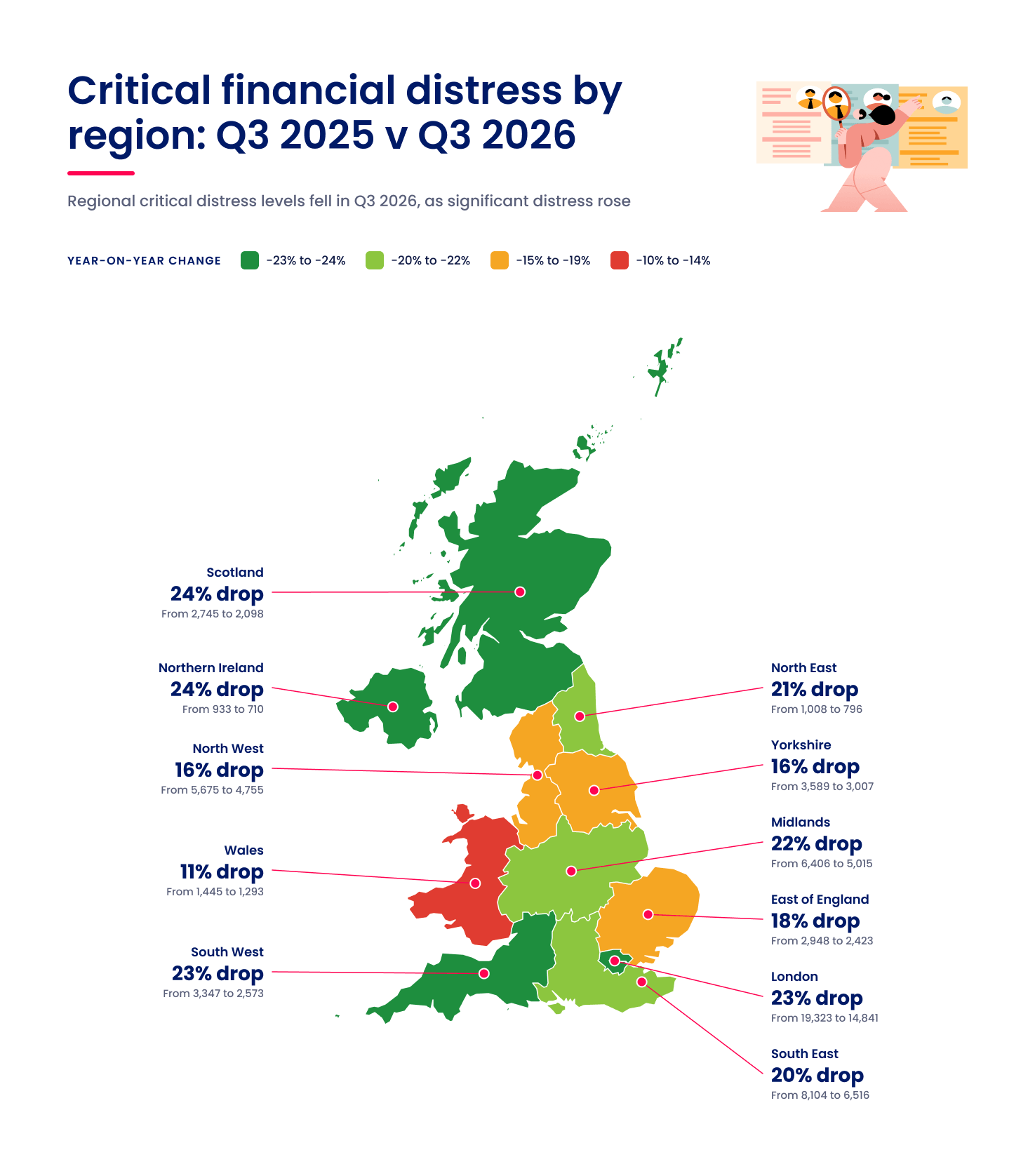
London had the highest number of SMEs in critical financial distress in Q3 2026 (14,841), but critical distress fell year-on-year in all eleven UK regions.
This is a change from Q2 2026, when Northern Ireland was the only region to record a year-on-year fall in critical distress.
While critical distress fell across the country, significant distress is also concentrated in the same regions. London had 234,058 businesses in significant distress in Q3 2026, followed by the South East (121,370) and the Midlands (86,289).
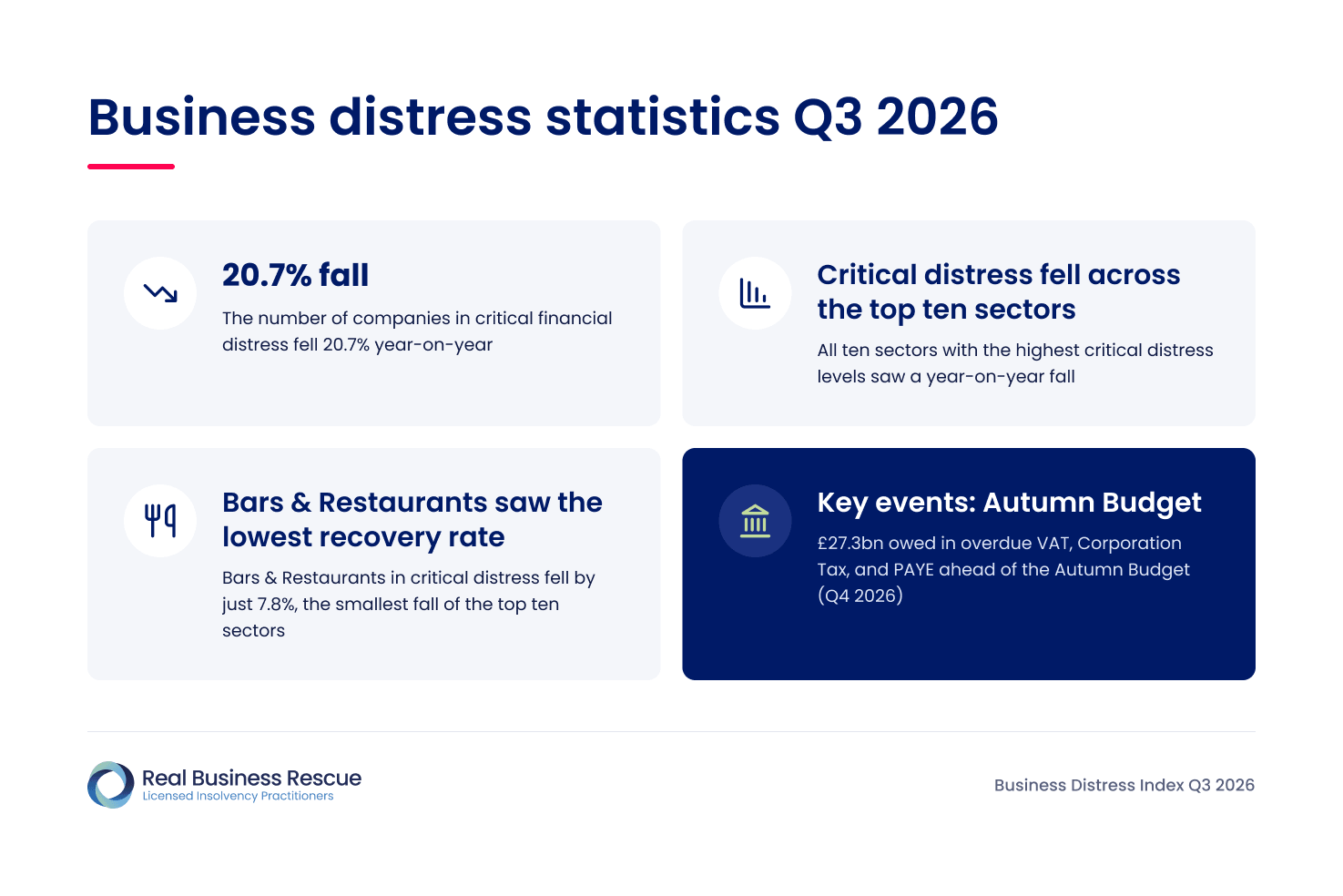
Q3 2026 closed with fewer SMEs in critical distress, and a record number in significant distress ahead of the Autumn Budget.
£27.3bn owed to HMRC
A Freedom of Information (FOI) request made by BTG found that £27.3 billion was owed to HMRC in VAT, Corporation Tax and PAYE arrears as of 31 August 2026. The volume and value of HMRC recoveries remained high in Q2 2026, suggesting more enforcement activity may be on the horizon. As announced at the Autumn Budget, HMRC will be granted more powers to recover lower-value tax debts ranging up to £10,000 for companies.
Autumn Budget
The Autumn Budget on 28 October 2026 included no increase to the headline rates of income tax, National Insurance contributions, or VAT. Most of the support does not take effect until April 2027, including the business rates freeze and relief for retail, hospitality and leisure properties in England. This is the same month the National Living Wage increase applies. The energy price cap is also forecast to rise by 28% in January 2027, which is likely to put further pressure on household spending.
Our full Autumn Budget summary covers the key points SMEs must know.
“The Budget brings some relief for retail, hospitality, and leisure businesses in England, but most of it doesn’t arrive until April 2027. In the meantime, HMRC is still pursuing £27.3 billion in arrears. Directors shouldn’t plan around support that hasn’t landed yet.”
Shaun Barton, Partner, Real Business Rescue
How many UK SMEs are in critical financial distress?
44,033 SMEs were in critical financial distress in Q3 2026, down 20.7% from 55,530 in Q3 2025.
How many UK SMEs are in significant financial distress?
738,144 SMEs were in significant financial distress in Q3 2026, a record high and up 9.5% from 674,030 in Q2 2026.
Which sector has the most SMEs in critical financial distress?
Support Services, with 6,715 SMEs in critical financial distress in Q3 2026, down 23.7% year-on-year.
Which UK region has the most SMEs in critical financial distress?
London, with 14,841 SMEs in critical financial distress in Q3 2026, down 23% year-on-year.
The Business Distress Index is produced by Real Business Rescue, a licensed insolvency practice and part of BTG Begbies Traynor. The data comes from BTG’s Red Flag Alert, which has tracked the health of UK companies since 2004.


Whatever stage your business is at, our licensed insolvency practitioners will take the time to understand your business and your goals. We’ll then support you through whichever option you choose to go down, from restructuring and funding to closure, so you can make the right decision with confidence.

Share a few details and one of our experts will be in touch for a free, confidential conversation.
For Ltd Company Directors
What are you looking to do?
Choose below:
We provide free confidential advice with absolutely no obligation.
Our expert and non-judgemental team are ready to assist directors and stakeholders today.
Understand your company's position and learn more about the options available
Find your nearest office - we have more than 100 across the UK. Remote video and telephone meetings are also available

Free, confidential, and trusted advice for company directors across the UK