









60 Second Test
Understand your company's position and learn more about the options available

Require Immediate Support? Free Director Helpline: 0800 644 6080
Published:
UK small and medium-sized businesses entered the second half of 2026 waiting for clarity on the economic outlook as a new Prime Minister prepared to take office. In the meantime, many are seeing lower work volumes as consumer spending remains subdued, while inflationary pressures and volatile energy costs continue to squeeze margins. Technological advancements are changing how some businesses operate, but for many, rising operational costs are leaving directors with little room to absorb further shocks.
While the increase in critical financial distress levels has slowed compared to the previous year, the total number of businesses affected remains stubbornly high, and many company directors are having to make difficult decisions about the future of their business.
The Business Distress Index provides quarterly company insolvency statistics and assesses the financial health of small-to-medium businesses in the UK. It provides an in-depth sector and regional analysis, alongside exclusive commentary from Shaun Barton, National Online Operations Director at Real Business Rescue. The Business Distress Index uses data from Companies House and Red Flag Alert.
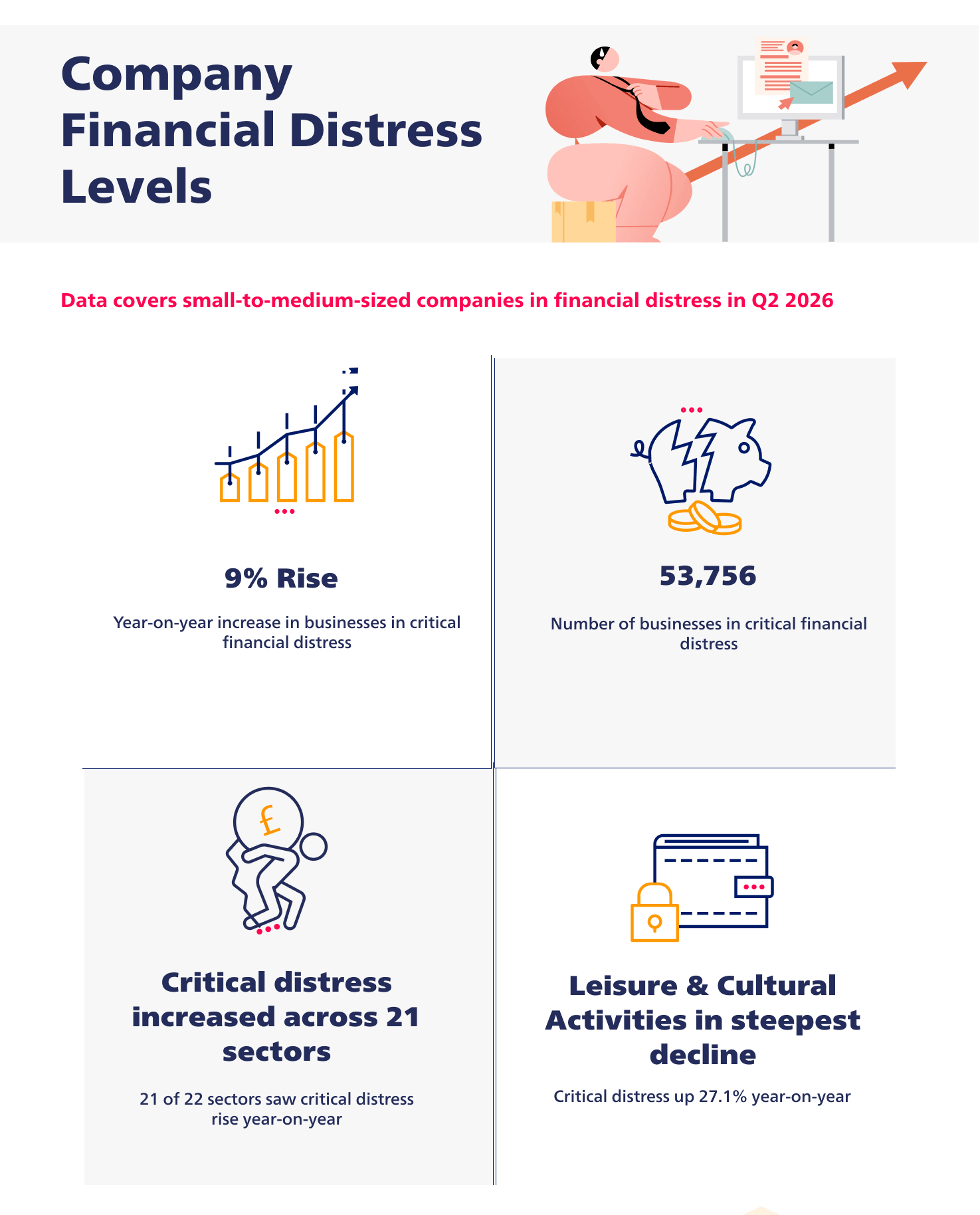
The Business Distress Index for Q2 2026 shows that critical financial distress has increased for another consecutive quarter, albeit at a more moderate rate than seen over the past year.
The number of companies in critical financial distress in Q2 2026 rose to 53,756, up 9.0% compared to the same period last year (Q2 2025: 49,309). This is a considerably smaller increase than the 21.4% year-on-year rise recorded in Q2 2025, suggesting the pace at which businesses are deteriorating may be starting to level off, even as the overall number of struggling businesses remains close to a record high.
Significant financial distress also increased over the year, albeit more gently, rising 1.1% to 674,030 businesses (Q2 2025: 666,876). This is a slowdown from the 10.8% annual increase seen this time last year.
While the headline figures suggest conditions may be stabilising rather than worsening, the level of financial distress monitored by the Business Distress Index remains historically high, and thousands of company directors are still contending with serious financial strain.
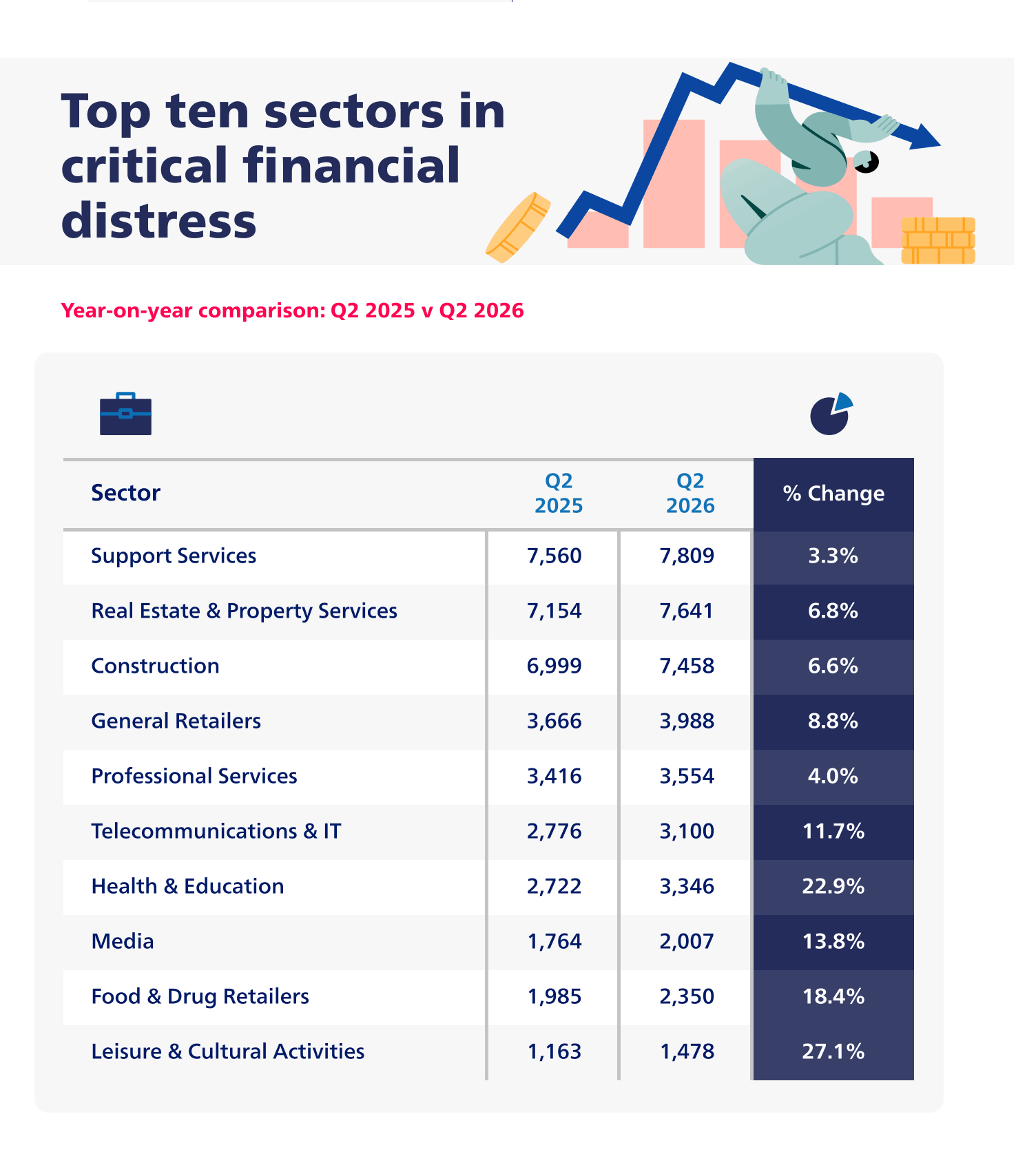
Every one of the ten largest sectors tracked by our Business Distress Index saw a rise in critical financial distress over the past year, underlining the widespread pressure on UK businesses. Consumer-facing industries are often the first to feel the impact when households cut back on budgets, such as Leisure & Cultural Activities, Hotels & Accommodation, and Sports & Health Clubs.
Leisure & Cultural Activities saw the sharpest rise in critical distress this quarter, up 27.1% to 1,478 businesses (Q2 2025: 1,163). As households navigate the cost of living crisis and higher energy bills, sectors dependent on discretionary spending bear the brunt.
Hotels & Accommodation followed closely, with critical distress up 26.6% to 510 businesses (Q2 2025: 403). Operators are exposed to shifts in travel and tourism spending, and rising energy and staffing costs continue to squeeze already thin margins. Sports & Health Clubs recorded a 21.0% rise in critical distress, to 980 businesses (Q2 2025: 810).
At the other end of the scale, Support Services, the sector with the highest overall number of critically distressed businesses, saw the smallest increase among the top ten sectors, up 3.3% to 7,809 (Q2 2025: 7,560). As a sector providing outsourced services to many industries, it tends to feel the knock-on effects when clients tighten their own spending, rather than direct pressures.
Construction rose 6.6% to 7,458 businesses in critical distress (Q2 2025: 6,999), continuing to contend with high material costs, labour shortages, and high-interest borrowing. However, it was the only sector to see a year-on-year fall in significant financial distress, down 0.7% to 101,568 businesses (Q2 2025: 102,285) - a possible early sign of stabilisation for some firms.
Professional Services increased 4.0% to 3,554 businesses (Q2 2025: 3,416). Firms in this sector often see softer demand when clients delay non-essential legal, accounting, or consultancy work during uncertain trading conditions. Real Estate & Property Services saw one of the steepest rises in significant financial distress, up 9.0% to 88,855 businesses (Q2 2025: 81,516), as higher borrowing costs continue to weigh on transaction volumes and property valuations.
Shaun Barton, National Online Operations Director at Real Business Rescue, said:
“The fact that critical distress is still rising, even as the pace slows down, tells us pressure on smaller businesses hasn’t gone away. We speak to directors every day who have been absorbing higher costs for so long, there’s very little room left to manoeuvre unexpected costs or financial shocks.”
“While some sectors and regions are finding a way through, others are being squeezed much harder. With winding up petitions rising and HMRC actively pursuing tens of billions in overdue tax, we expect more directors to be forced into a decision about their company’s future in the coming months. Acting early gives directors far more options than waiting until things become critical.”
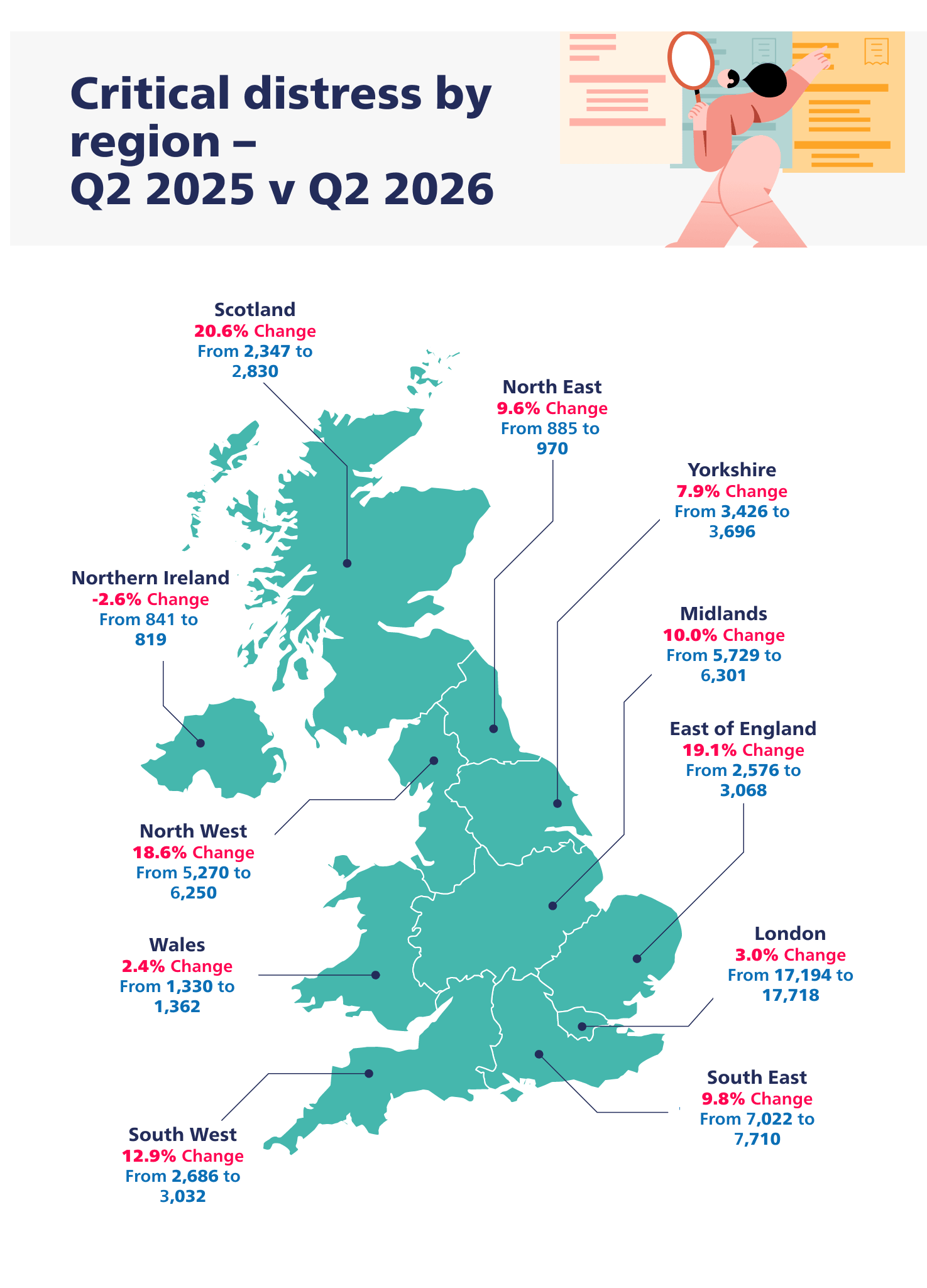
The regional picture is mixed. London continues to have the highest number of businesses in critical financial distress, at 17,718, though this represents one of the smallest annual increases of any region, up 3.0% on Q2 2025 (17,194). The sharpest regional increases were seen in Scotland (+20.6%, from 2,347 to 2,830), East of England (+19.1%, from 2,576 to 3,068), and the North West (+18.6%, from 5,270 to 6,250).
Northern Ireland was the only region to buck the national trend entirely, recording a small fall in critical financial distress, down 2.6% year-on-year to 819 businesses (Q2 2025: 841). Wales also saw a modest rise, up 2.4% to 1,362.
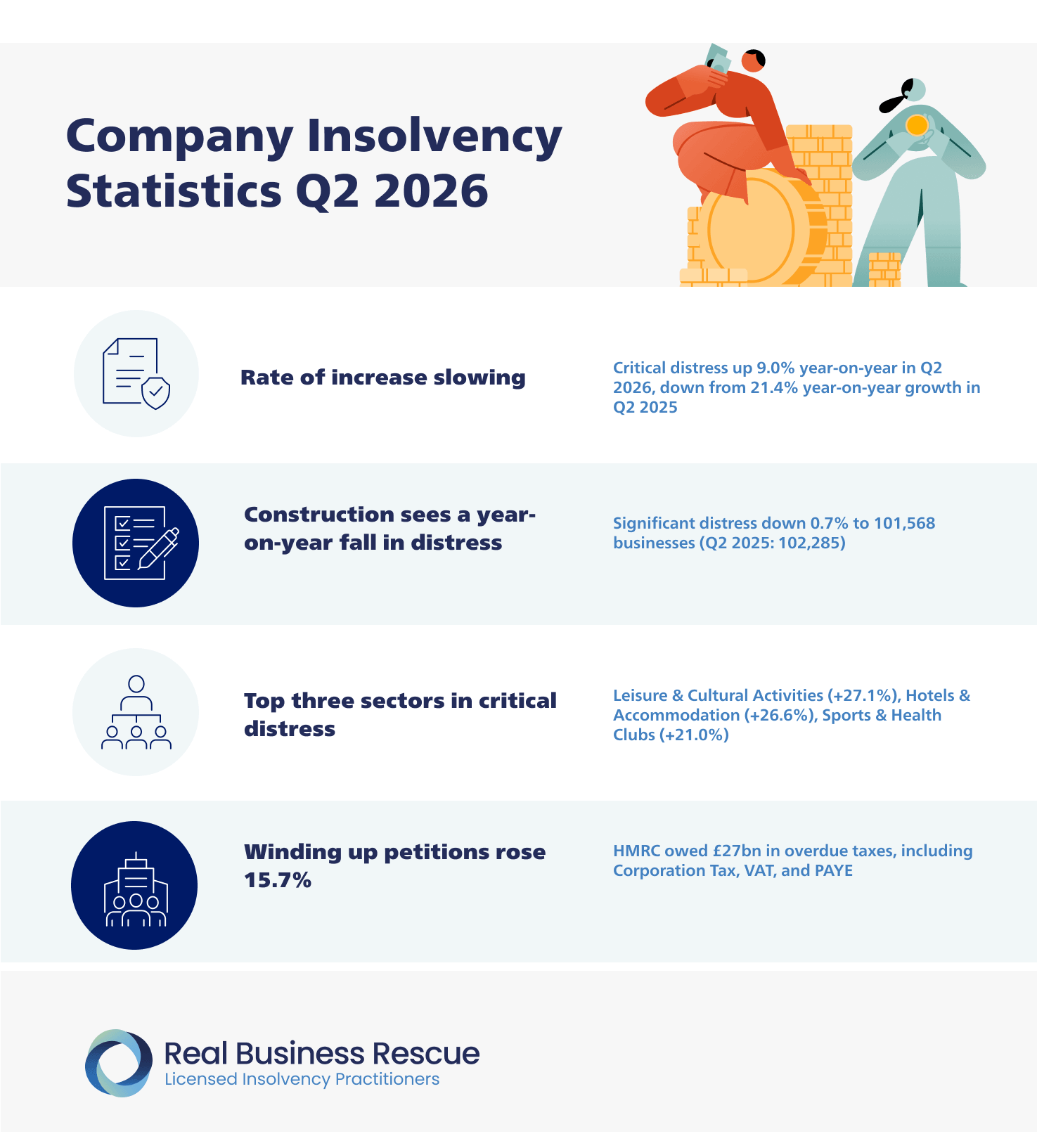
Looking ahead, there are signs that pressure on struggling businesses could increase further. Ministry of Justice figures show that winding up petitions rose 15.7% in 2025 to 6,411 (2024: 5,543), as HMRC pursues an estimated £27 billion in overdue Corporation Tax, VAT, and PAYE. We are already witnessing signs that creditors, including HMRC, are growing less patient with businesses that are behind on payments.
With energy costs and inflation expected to remain under scrutiny in the months ahead, and businesses awaiting greater clarity from the government, many company directors will be keeping a close eye on their financial position over the second half of 2026.


Still unsure whether liquidation is right for your company? Don't worry, the experts at Real Business Rescue are here to help. Our licensed insolvency practitioners will take the time to understand the problems your company is facing before recommending the best course of action going forward based on your own unique circumstances.

Complete the below to get in touch
For Ltd Company Directors
What are you looking to do?
Choose below:
We provide free confidential advice with absolutely no obligation.
Our expert and non-judgemental team are ready to assist directors and stakeholders today.
Understand your company's position and learn more about the options available

Find your nearest office - we have more than 100 across the UK. Remote video and telephone meetings are also available

Free, confidential, and trusted advice for company directors across the UK