








60 Second Test
Understand your company's position and learn more about the options available

Require Immediate Support? Free Director Helpline: 0800 644 6080
Small to medium businesses across the country are navigating treacherous trading conditions fuelled by high inflation, high borrowing costs and high taxes. With budgets slimmed down, yet overheads rising, the stakes are high for businesses already struggling to break even. Many are still recovering from the tax hikes announced as part of the Spring Statement which inflated employee costs. With the Autumn Budget looming, there looks to be little respite in store for British businesses.
The Business Distress Index provides quarterly company insolvency statistics and assesses the financial health of small-to-medium businesses in the UK. It provides an in-depth sector and regional analysis, alongside exclusive commentary from Shaun Barton, Online Business Operations Manager at Real Business Rescue. The Business Distress Index uses data from Companies House and Red Flag Alert.
The Business Distress Index for Q3 2025 paints a drastically worsening picture of financial health. Financial distress is categorised as ‘significant’ or ‘critical’ which refers to businesses with deteriorating working capital, retained profits, net worth and contingent liabilities.
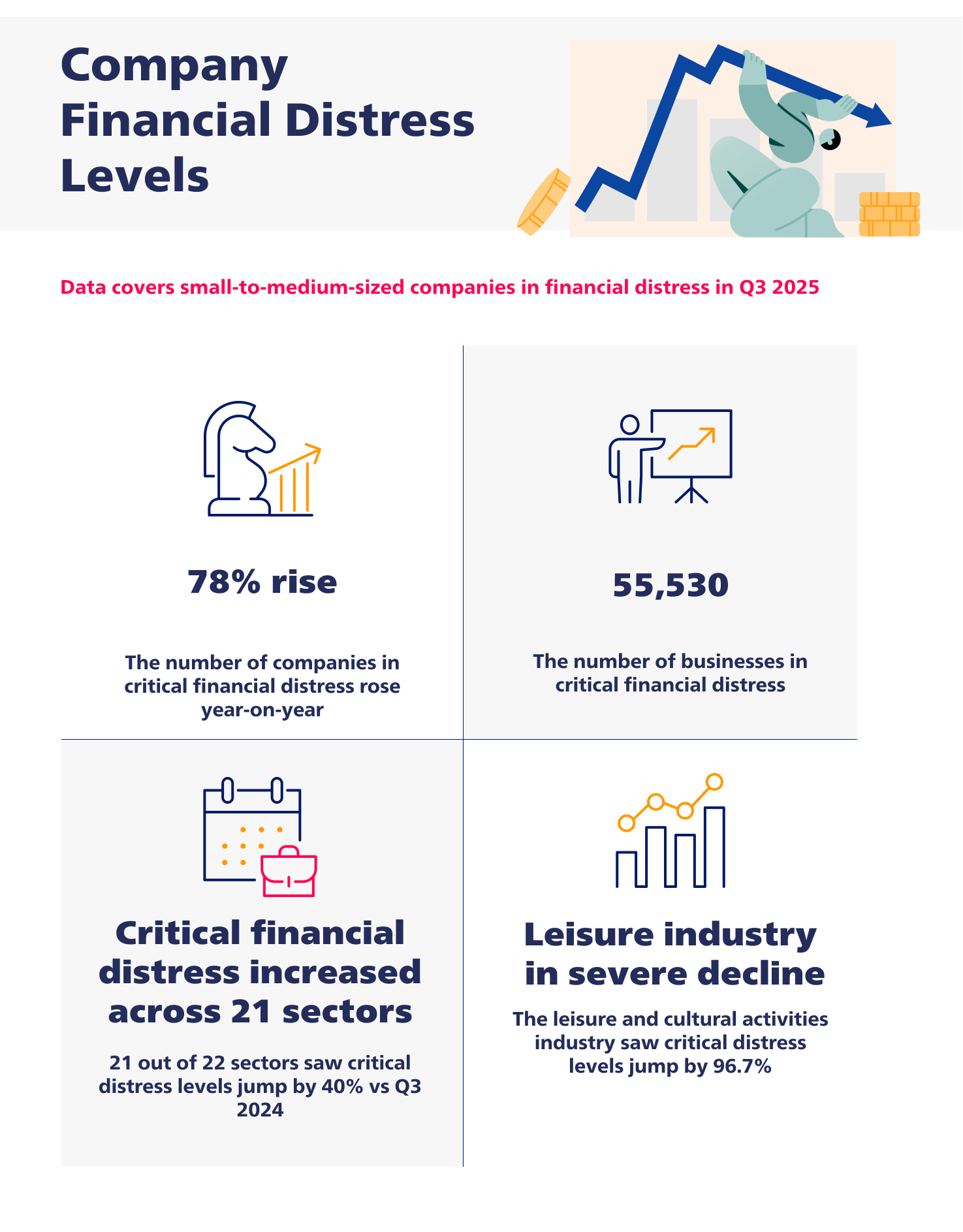
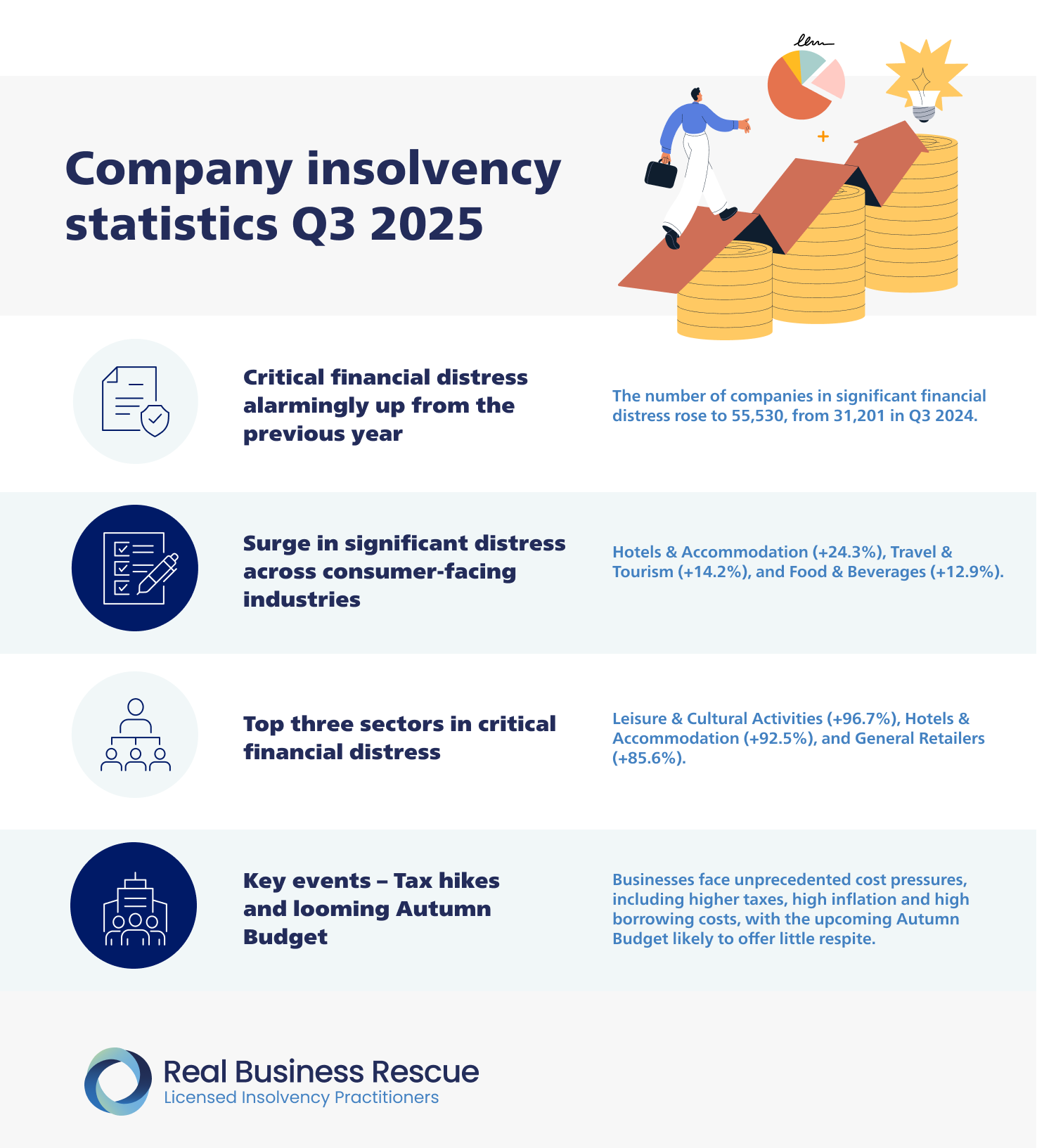
The number of companies in critical financial distress in Q3 2025 was 55,530 which shows a substantial 78% increase over the last 12 months (Q3 2024: 31,201). Compared to the previous quarter, this is a 12.6% increase (Q2 2025: 49,309). The health of British businesses has significantly dipped over the last year as tax increases came as a blow to businesses already on their knees. With growing costs to contend with amid an increasingly bitter trading environment, the battle for survival poses a real threat to UK businesses.
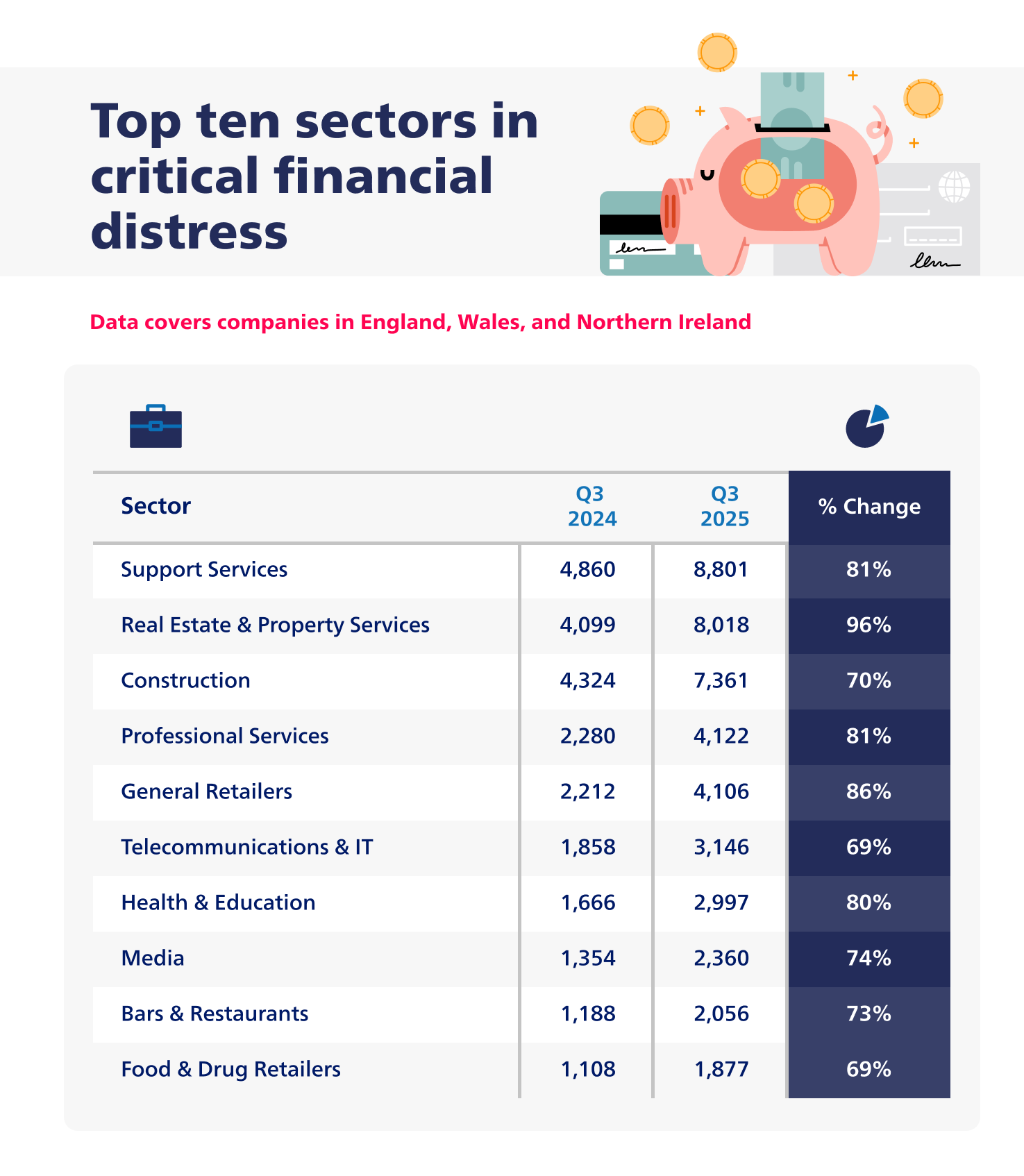
The Business Distress Index analyses key sectors that are the main feeders into the UK economy. Out of 22 sectors assessed, 21 sectors saw critical financial distress levels rise by more than 40% compared to Q3 2024. This shows a dramatic financial decline over the last 12 months which may well increase the risk of insolvency.
The industries experiencing high degrees of financial pressure are consumer facing, a trend that continues from the previous Business Distress Index. The most extreme cases of critical financial distress include leisure & cultural activities (+96.7%), hotels & accommodation (+92.5%) and general retailers (+85.6%).
As the cost of living crisis endures and stifles consumer demand, businesses in much need of a cash boost are finding their pockets dry. If consumer spending fails to revive, company insolvencies may be inevitable.
On the significant financial distress front which highlights a less terminal case of financial distress, albeit equally worrying, 18 out of 22 sectors experienced a substantial rise over the last 12 months. The top three sectors include utilities (+35.8%), real estate & property services (+31.8%) and financial services (+22.2%).
Shaun Barton, National Online Operations Director at Real Business Rescue, said:
“British businesses are operating under high pressure conditions as the shock from high inflation, rising interest rates and strained international trade reverberates through the economy. It is an equally gloomy period for consumers as disposable cash is diverted to cover household spending as the cost of living skyrockets.
“Without consumer demand, the supply and demand cycle is broken and businesses are unplugged from the fuel essential to survive. Companies operating with no financial cushion may be exposed to a higher risk of insolvency. With high inflation showing no signs of abating, this could lead to a tidal wave of business closures.
“There is much apprehension surrounding the upcoming Autumn Budget as the Chancellor pulls up her sleeves to tackle a multimillion-pound shortfall in public finances. In light of this, it’s unlikely that there will be any major wins for small businesses as the Chancellor seeks to balance the books.”
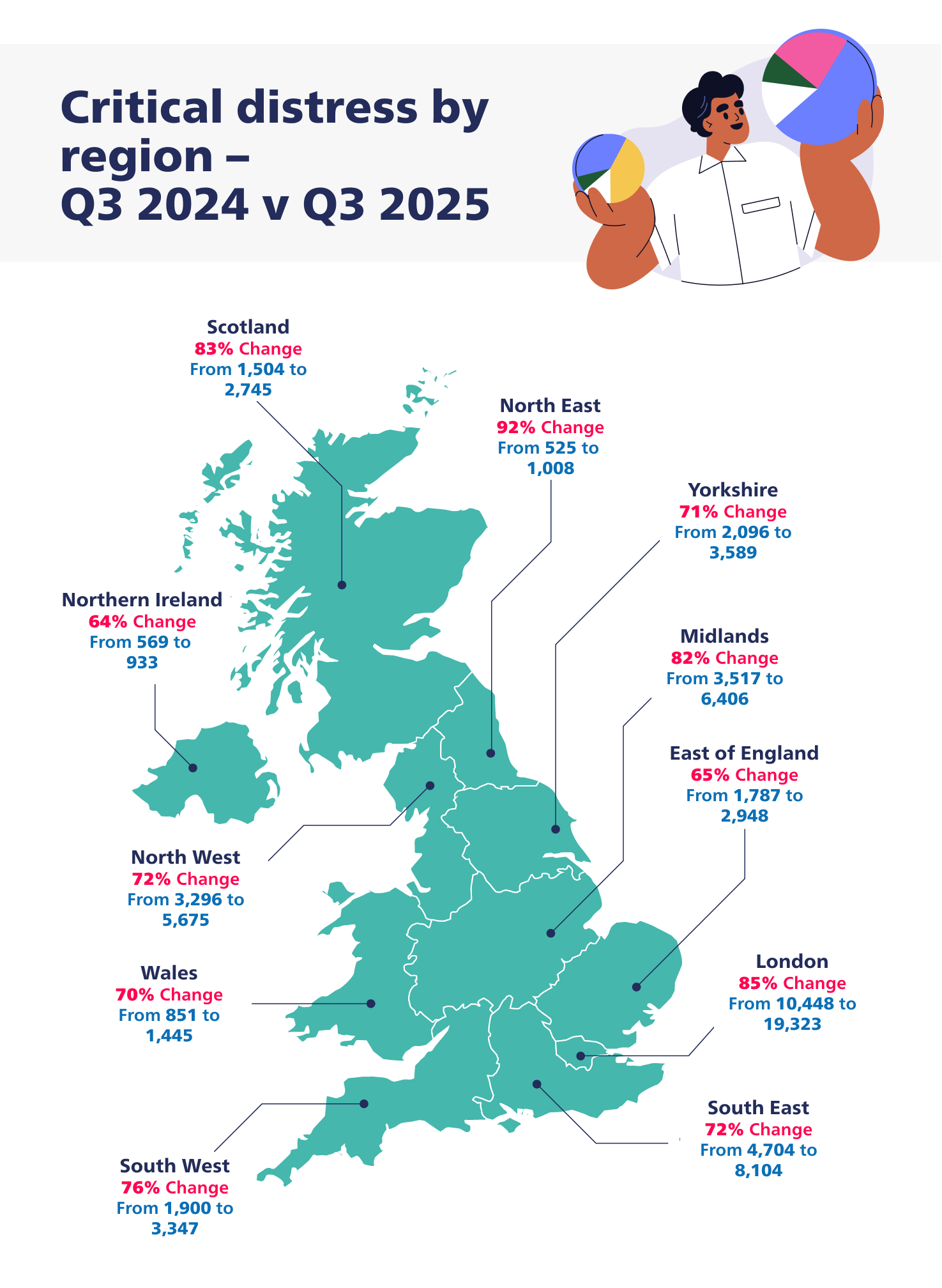
After London, which is the epicentre of business activity in the UK, the region with the highest number of critically distressed businesses was the South East (8,104), followed by the Midlands (6,406) and North West (5,675). The North East experienced the greatest change in critical financial distress levels at 92% as the number of businesses in this category jumped from 525 in Q3 2024 to 1,008 in Q3 2025.
The current state of the economy emits uncertainty for businesses and consumers alike, slowing down business activity and stifling consumer demand. With little hope arising from the Autumn Budget, businesses must remain resilient and financially aware to curb the risk of insolvency.

For Ltd Company Directors
What are you looking to do?
Choose below:
We provide free confidential advice with absolutely no obligation.
Our expert and non-judgemental team are ready to assist directors and stakeholders today.
Understand your company's position and learn more about the options available
Find your nearest office - we have more than 100 across the UK. Remote video and telephone meetings are also available

Free, confidential, and trusted advice for company directors across the UK